Some people claim that not enough of the waste from homes is recycled. They say that the only way to increase recycling is for governments to make it a legal requirement.
To what extent do you think laws are needed to make people recycle more of their waste?
Give reasons for your answer and include any relevant examples from your own knowledge or experience.
————————————
我写的:
Some people believe that not enough household waste is recycled, and that the only way to improve recycling rates is for governments to introduce legislation. I partly agree with this viewpoint, as legislation is only one of several effective measures. In order to improve the recycle rate of household waste, convenient systems and economic incentives are necessary.
First of all, legislation play a vital role in home waste recycling. Household waste recycling is not only useful for individuals but also have benefits to the public environment. While there are still a lot of people do not obey the recycling rules such as throw rubbishes away anywhere, or mixed different kinds of wastes. Thus, this is not only a moral issue, but also a legal issue. Therefore, legislation can not only improve people's awareness of environment protection but also conducive to waste utilization. For example, in Shanghai of China, after the implementation of garbage classification legislation five years ago, this city becomes more clean and tidy now.
However, waste recycling legislation alone is not enough, because the cost of law enforcement is too high. Governments should take several measures to achieve their goals. Firstly, to build convenient recycle system, such as provide clear illustrations, standardize classification bins, and increase the frequency of collection and transportation. Secondly, introducing economic mechanisms. For instance, set a deposit return system that provides direct benefits for bottle, or charging for the packing fee so that households generate more waste will afford higher costs.
In conclusion, legislation for home waste recycling is necessary, but it is not the only solution. Governments can still take convenient systems and economic incentives into consideration. Only in these ways, can we protect the environment properly.
——————————————
IELTS9. ME 打6.5分,批改:
1.improve the recycle rate
'Recycle rate'这个说法有些别扭,建议用 'recycling rate(回收率)',这样表达会更符合学术习惯.
2.动词与主语不一致:‘legislation play‘应该是 ‘legislation plays a vital role。
3.'home waste recycling'这个表达用得比较少,你可以考虑使用 'household waste recycling(家庭垃圾回收)',这样会更准确和正式一些.
4.there are still a lot of people do not obey the recycling rules建议补充上'who',这样更符合英语表达习惯.
5.throw rubbishes away' Rubbishes'这个词是不正确的,建议使用 'rubbish(垃圾)
6.'Mixed different kinds of wastes'这个表达有点不自然,建议使用'mix different kinds of waste.
7.can not only improve people's awareness of environment...
应该写成'can not only improve people's awareness of environmental protection but also be conducive to waste utilization(不仅可以提高人们的环保意识,而且有助于废物的利用)'.
8.in Shanghai of China
表达有些不自然.建议你改为'in Shanghai, China ',这样更标准.
9.修改为:the city has become cleaner and tidier.'
10.to build convenient recycle system 修改为 "to build a convenient recycling system
11.'for bottles'
12.'charging for excessive packaging
13.正确表达应该是'Only in these ways can we properly protect the environment.'(只有通过这些方式,我们才能真正保护环境).在'ways'之后不需要加逗号.
——————————————————————————————————
范文参考:
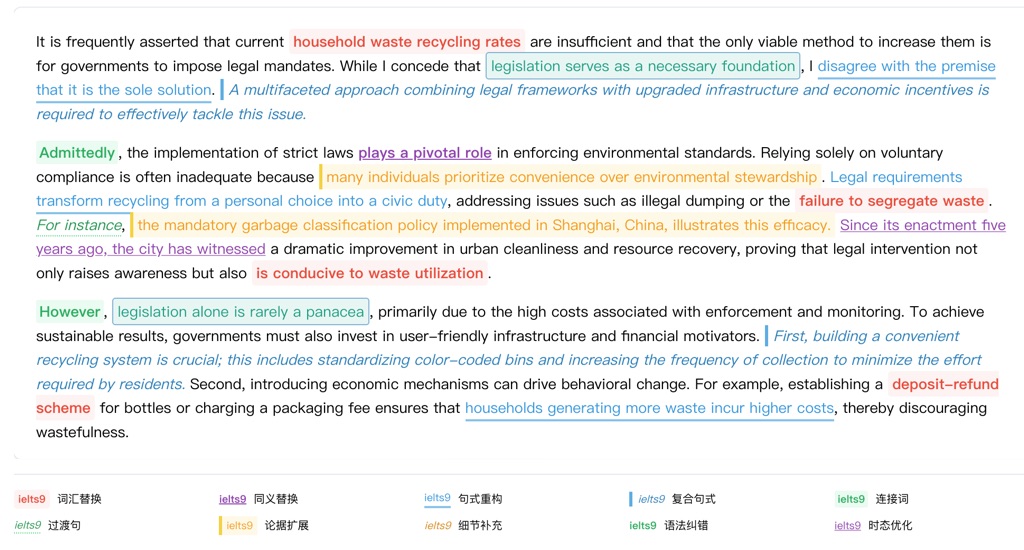 It is frequently asserted that current household waste recycling rates are insufficient and that the only viable method to increase them is for governments to impose legal mandates. While I concede that legislation serves as a necessary foundation, I disagree with the premise that it is the sole solution. A multifaceted approach combining legal frameworks with upgraded infrastructure and economic incentives is required to effectively tackle this issue.
Admittedly, the implementation of strict laws plays a pivotal role in enforcing environmental standards. Relying solely on voluntary compliance is often inadequate because many individuals prioritize convenience over environmental stewardship. Legal requirements transform recycling from a personal choice into a civic duty, addressing issues such as illegal dumping or the failure to segregate waste. For instance, the mandatory garbage classification policy implemented in Shanghai, China, illustrates this efficacy. Since its enactment five years ago, the city has witnessed a dramatic improvement in urban cleanliness and resource recovery, proving that legal intervention not only raises awareness but also is conducive to waste utilization.
However, legislation alone is rarely a panacea, primarily due to the high costs associated with enforcement and monitoring. To achieve sustainable results, governments must also invest in user-friendly infrastructure and financial motivators. First, building a convenient recycling system is crucial; this includes standardizing color-coded bins and increasing the frequency of collection to minimize the effort required by residents. Second, introducing economic mechanisms can drive behavioral change. For example, establishing a deposit-refund scheme for bottles or charging a packaging fee ensures that households generating more waste incur higher costs, thereby discouraging wastefulness.
In conclusion, while making recycling a legal requirement is undoubtedly necessary, it is not the only path forward. Governments should integrate comprehensive systems and economic incentives alongside the law. Only through this holistic approach can we properly protect the environment for future generations.
——————————————-
GPT 打分6.5: 修补:
Some people believe that not enough household waste is recycled, and that the only way to improve recycling rates is for governments to introduce legislation. I partly agree with this viewpoint, because laws are just one of several effective measures. To raise household recycling rates substantially, governments also need convenient systems and economic incentives.
First of all, legislation plays a vital role in household waste recycling. Recycling does not only benefit individual households; it also protects the wider environment. However, many people still fail to follow recycling rules, for example by littering or mixing different types of waste together. This is therefore not merely a moral issue but also a matter of public regulation. Clear laws, backed by penalties, can set a minimum standard of behaviour and encourage better waste sorting and resource recovery. For instance, in Shanghai, after mandatory waste-sorting rules were introduced, public spaces became noticeably cleaner and residents had stronger incentives to separate their rubbish properly.
However, legislation alone is not enough, because enforcement can be expensive and inconsistent. Governments should combine laws with other practical measures. One important step is to build a more convenient recycling system, such as providing clear illustrations, standardising sorting bins, and increasing the frequency of collection. Another effective approach is to introduce economic mechanisms. For example, a deposit-return scheme can reward people for returning bottles and cans, while “pay-as-you-throw” fees can make households that produce more general waste pay more, which indirectly encourages recycling and waste reduction.
In conclusion, laws are necessary to improve household recycling, but they are not the only solution. If governments want long-term, widespread participation, they should also invest in user-friendly systems and well-designed financial incentives.